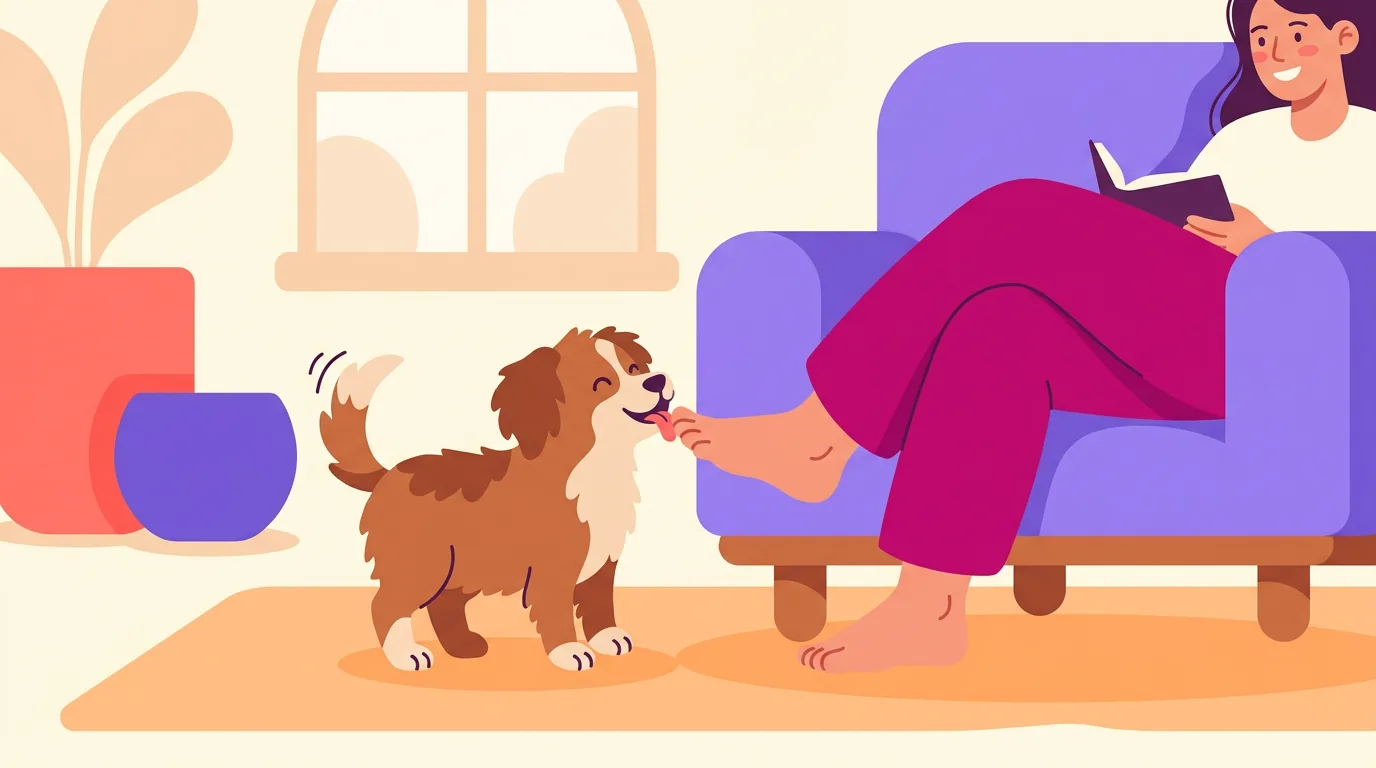
Why Does My Dog Lick My Feet? (It’s Weirder — and Sweeter — Than You Think)
 🐶 Dog Mystery
The short answer
Foot-licking is usually affection, attention-seeking, and a fascination with your scent (feet are a salty, info-packed buffet to a dog). Occasionally it’s anxiety or a compulsive habit worth redirecting.
Of all the places a dog could choose, feet are the least flattering and the most popular. There is a reason for that, and it is a combination of chemistry, instinct and the fact that feet are simply the part of you a dog can reach without being told to get down.
Your feet are the most informative part of you
Feet have a very high density of sweat glands — among the highest anywhere on the body. That sweat carries salt, and it carries a dense chemical signature: hormones, metabolic by-products, traces of everywhere you have walked.
A dog's sense of smell operates on a scale that makes this worth investigating. Dogs also possess a vomeronasal organ, which detects pheromones and chemical signals that ordinary smell does not pick up. Licking pulls those compounds into contact with it directly. Your feet are, to a dog, the most information-dense and easily accessible surface available — a status update on where you have been and how you are doing.
The other reasons
- Salt. The simplest explanation and often the correct one, especially after exercise or on a warm day.
- It is a bonding behaviour with deep roots. Mothers lick puppies from birth to clean and stimulate them, and puppies lick each other and their mother. Licking is one of the first social behaviours a dog performs and it stays wired to comfort and connection.
- Appeasement. Licking is a deferential signal in dog-to-dog communication, used to defuse tension and signal non-threat. Directed at you, it can mean much the same thing.
- It works. Licking your feet reliably produces a reaction — laughing, talking, moving, pushing the dog away. All of that is attention, and attention reinforces.
- Self-soothing. Licking releases endorphins in the dog, which is why it becomes a comfort behaviour and why it can tip into compulsion.
The greeting-ritual origin
There is one more strand worth knowing. Wolf and wild-dog puppies lick the muzzles of returning adults, which stimulates regurgitation of food. The behaviour survives in domestic dogs as a ritualised greeting — dogs lick the faces of dogs and people they are pleased to see.
Most humans, however, keep their faces well out of range. Feet are the accessible substitute. A dog that meets you at the door and goes straight for your ankles is very likely running the face-greeting routine at the only altitude available to it.
Redirect rather than scold
If you dislike it, do not push the dog away or shout — for an attention-motivated dog, that is a reward. Stand up and walk away calmly instead, removing the target entirely. Then immediately give attention for something else: a sit, a settle on a mat, a chew. You want an alternative behaviour that pays better, not a punished one.
When licking stops being normal
Occasional foot-licking is unremarkable. The pattern to watch for is licking that has become compulsive — a dog that licks obsessively regardless of context, cannot easily be interrupted, and returns to it as soon as you stop redirecting.
Veterinary behaviour guidance describes excessive licking as a possible sign of anxiety, boredom or pain rather than affection. If the licking is directed at the dog's own paws or legs rather than at you, that is a different and more common problem: allergies, skin infection, and joint pain are frequent causes, and persistent paw-licking produces the reddish-brown staining owners often notice first.
Worth a vet appointment
Book a check if your dog licks its own paws or legs raw, if there is redness, swelling, hair loss, discharge or a smell, if the licking is new and intense, or if it comes with pacing, panting, hiding, or distress when left alone. Also see a doctor yourself if your dog licks broken skin, a surgical wound, or a diabetic foot ulcer — dog saliva carries bacteria including Capnocytophaga, which is uncommon but can cause serious infection in people who are immunosuppressed or without a functioning spleen.
Is it hygienic?
For a healthy person with intact skin, having a dog lick your feet carries low risk. Wash afterwards, do not let a dog lick broken skin or wounds, and keep your dog's parasite prevention current.
Be more careful if you are immunosuppressed, pregnant, elderly, or managing diabetes — foot ulcers in particular should never be licked. In those situations the sensible approach is to redirect the behaviour rather than tolerate it.
Should you stop it?
If you do not mind it, there is no reason to. It is normal, deeply rooted social behaviour and for most dogs it is a sign of comfort and connection rather than a problem.
If you do mind it, the effective approach is consistency across everyone in the household — a behaviour that is tolerated by one person and punished by another persists indefinitely — plus a well-rewarded alternative, and enough physical and mental exercise that the dog is not licking out of boredom. Sniffing walks, food puzzles and training games do more here than any correction will.
Gear that actually helps
Hand-picked for this behavior. We may earn a small commission — at no cost to you.
Frequently asked
Why does my dog lick my feet specifically?
Feet have one of the highest concentrations of sweat glands on the body, so they carry salt and a dense chemical signature about where you have been. Dogs also have a vomeronasal organ that detects chemical signals, and licking delivers those compounds to it. Feet are also simply the most accessible part of you.
Does foot-licking mean my dog loves me?
It usually indicates comfort and social connection. Licking is one of the first social behaviours a dog performs, it is wired to early maternal care, and it releases endorphins. It can also be appeasement or straightforward attention-seeking.
Is it safe to let my dog lick my feet?
For a healthy person with intact skin, the risk is low — wash afterwards and keep parasite prevention current. Never allow licking of broken skin, wounds or diabetic foot ulcers, and redirect entirely if you are immunosuppressed or pregnant.
When is licking a sign of a problem?
When it becomes compulsive — hard to interrupt, happening regardless of context, and resuming immediately. Excessive licking can indicate anxiety, boredom or pain. Licking directed at the dog's own paws more often means allergies, skin infection or joint pain and needs a vet.
How do I get my dog to stop licking my feet?
Stand up and walk away rather than pushing or scolding — for an attention-seeking dog, a reaction is a reward. Immediately reward an alternative like settling on a mat. Be consistent across everyone in the household, and make sure the dog has enough exercise and mental stimulation.
Why does my dog lick my feet right when I get home?
That is likely a ritualised greeting. Wild canid puppies lick the muzzles of returning adults, and domestic dogs kept the behaviour as a greeting. Your face is out of range, so your feet are the substitute.
Sources
Every claim on this page is checked against published veterinary and animal-behaviour research. Here’s where it comes from.
- 1Why Does My Dog Lick My Feet? — American Kennel Club
- 2Why do dogs lick humans? — VCA Animal Hospitals
- 3Why Does My Dog Lick Me? Why Do Dogs Lick People? — American Kennel Club
Keep exploring
Why Does My Dog Lick His Paws So Much?
A quick clean is fine, but nonstop paw-licking is your dog telling you something’s wrong. Here’s how to decode it.
Why Does My Dog Lick the Floor?
Your dog treats the kitchen floor like a plate. Usually it’s crumbs — but sometimes it’s a clue. Here’s how to tell.
 🐶 Dog Mystery
Why Does My Dog Lick My Face? Kisses, Instinct & Hygiene
Are they really “kisses”? Mostly yes — with a dash of instinct and a taste for your skin. Here’s what’s behind the face baths.
 🐶 Dog Mystery
Why Does My Dog Lick My Hands? Love, Salt & Information
Your hands are basically a newspaper, a snack, and a love language to your dog — all at once. Here’s the breakdown.
 🐶 Dog Mystery
Why Does My Dog Sleep at My Feet? Loyalty, Warmth & the Pack
Your dog could sleep anywhere, but they pick your feet. It’s loyalty, security, and a little bodyguard instinct rolled into one.
 🐶 Dog Mystery
Why Does My Dog Sit on My Feet? Closeness, Comfort & Claiming You
Plopping right onto your feet isn’t your dog being bossy — it’s one of the sweeter things they do. Here’s the real meaning.