 🐶 Dog Mystery
The short answer
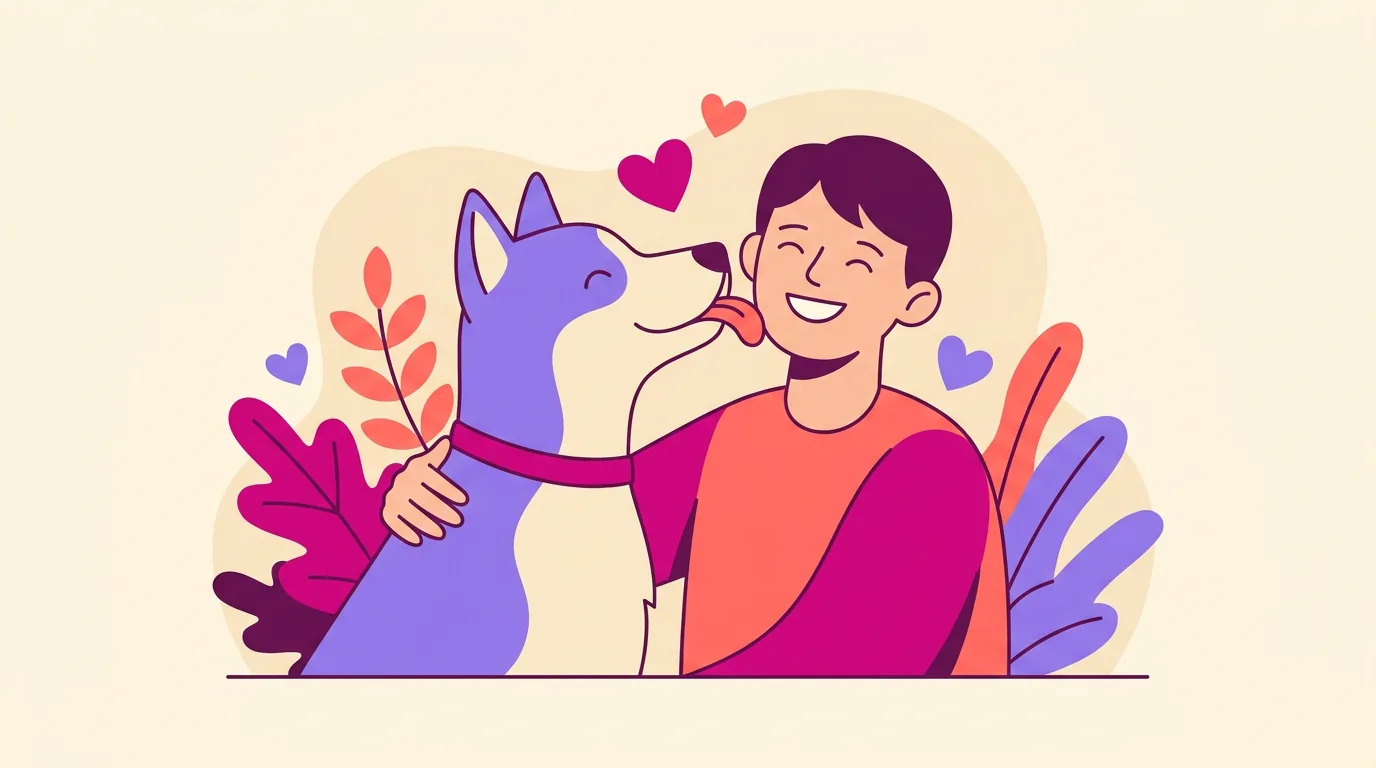
Face-licking is affection, greeting, and a deep-rooted instinct (puppies lick adult dogs’ mouths), plus dogs love the taste and scent of your skin. It releases feel-good endorphins — and usually gets a reaction from you.
Face-licking is the most loaded version of dog licking, because it is the one with the clearest evolutionary origin and the one with the most legitimate hygiene caveats. Both are worth understanding, because the answer to 'should I let him?' genuinely depends on who you are.
It began as a food request
Wolf and wild-dog puppies lick the muzzles of returning adults, and that licking stimulates the adult to regurgitate food. It is a functional behaviour with a clear payoff, performed by young animals toward older ones.
Domestic dogs kept the motor pattern and lost the function. What survives is a ritualised greeting: dogs lick the faces of dogs and people they are pleased to see. A dog that meets you at the door and goes for your face is running an ancient welcome-home routine, not asking to be fed.
The other reasons
- Affection and bonding. Licking releases endorphins in the dog, which makes it calming to perform as well as social to receive. Mothers lick puppies from birth, so the behaviour is wired to comfort from the very beginning.
- Appeasement. Licking upward at the face is a deferent signal in dog-to-dog communication, used to defuse tension. Directed at a person it can mean the same thing — particularly from a dog that is unsure.
- Taste. Human skin is salty, and faces carry residue from food, moisturiser and sweat. This is less charming and frequently part of the answer.
- It works. Face-licking reliably produces a reaction — laughing, talking, pushing away. All of that is attention, and attention reinforces.
- Information gathering. Faces carry a great deal of chemical information, and dogs have a vomeronasal organ that detects compounds ordinary smell does not. Licking delivers them to it.
Reading it correctly
Not all face-licking is friendly enthusiasm, and the distinction matters around children in particular.
Relaxed, affectionate licking comes with a loose, wiggly body, a wagging tail that moves the whole rear end, an open mouth and soft eyes. The dog approaches, licks, and moves away easily.
Appeasement licking looks different: the body is lower, the ears are back, the tail is low, and the licking is quick and repeated, often with the dog turning its head away between licks. That is a dog trying to reduce tension, and it usually means it would prefer more space rather than more contact.
A third pattern is worth naming because it is frequently misread. Lip-licking and tongue-flicking directed at nothing in particular, with a stiff body, is a stress signal — not affection. When it happens as a child leans over a dog, it is the dog asking for the interaction to stop.
Children and face-licking
Teach children not to put their faces close to a dog's face, however friendly the dog. Face-to-face contact at close range removes a dog's ability to move away and is one of the most common human behaviours preceding a facial bite — and children are bitten in the face disproportionately for exactly this reason. Supervise all interactions between dogs and young children, and treat a dog that licks then turns its head away as asking for space.
The hygiene question, answered properly
For a healthy adult with intact skin, letting a dog lick your face is low risk. It is not zero risk, and the caveats are specific rather than general.
- Avoid the mouth, eyes and nose. Mucous membranes are the practical route of transmission, and this is where the risk sits.
- Never on broken skin. Cuts, surgical wounds, acne lesions and diabetic ulcers should not be licked.
- Be cautious if you are immunosuppressed, pregnant, elderly or an infant is involved. Dog saliva carries bacteria including Capnocytophaga, which is rare but can cause serious illness in people who are immunosuppressed or without a functioning spleen.
- Keep parasite prevention current. Dogs that eat faeces or hunt carry a higher parasite burden, and some parasites are transmissible to people.
The claim that a dog's mouth is 'cleaner than a human's' is a persistent myth. It is not cleaner — it simply contains different organisms, most of which are not adapted to us. That is why the risk is low rather than absent.
If you would rather it stopped
Turn away, do not push away
Pushing a dog off is physical contact and often reads as play, which makes it a reward. Turn your head or stand up and step away instead — remove the target entirely. Then immediately pay for something else: a sit, a hand touch, a settle on a mat. You want a better-paid alternative rather than a punished behaviour, and consistency across everyone in the household matters more than any single technique.
When licking becomes a problem
Occasional face-licking is normal social behaviour. Licking that is relentless, hard to interrupt, and continues regardless of context is different.
Veterinary behaviour guidance describes excessive licking as a possible indicator of anxiety, boredom or pain rather than affection. If your dog licks obsessively, cannot easily be redirected, and resumes the moment you stop, that is worth a conversation with your vet — as is any sudden change in how much a dog licks, which can accompany nausea or discomfort.
Gear that actually helps
Hand-picked for this behavior. We may earn a small commission — at no cost to you.
Frequently asked
Why does my dog lick my face?
It began as a puppy behaviour: wolf and wild-dog pups lick returning adults' muzzles to stimulate food regurgitation. Domestic dogs kept it as a ritualised greeting. Affection, appeasement, salt and simple attention-seeking all layer on top.
Is it safe to let my dog lick my face?
For a healthy adult with intact skin, the risk is low but not zero. Avoid the mouth, eyes and nose, never allow licking of broken skin or wounds, and be cautious if you are immunosuppressed, pregnant or elderly. Keep parasite prevention current.
Is a dog's mouth really cleaner than a human's?
No, that is a myth. It is not cleaner — it contains different organisms, most of which are not well adapted to humans. That is why the risk is low rather than absent.
Should I let my dog lick my child's face?
No. Teach children to keep their faces away from a dog's face regardless of how friendly the dog is. Close face-to-face contact removes the dog's ability to move away and is one of the most common behaviours preceding a facial bite, which children receive disproportionately.
How do I tell affectionate licking from stress licking?
Affectionate licking comes with a loose wiggly body, a whole-rear-end wag, open mouth and soft eyes. Appeasement licking is lower and quicker, with ears back, a low tail and head-turning between licks — that dog wants space, not more contact.
How do I stop my dog licking my face?
Turn your head or stand and step away rather than pushing — pushing is contact and often reads as play. Immediately reward an alternative like a sit or a settle. Be consistent across everyone in the household.
Sources
Every claim on this page is checked against published veterinary and animal-behaviour research. Here’s where it comes from.
- 1Why do dogs lick humans? — VCA Animal Hospitals
- 2Why Does My Dog Lick Me? Why Do Dogs Lick People? — American Kennel Club
- 3Compulsive Disorders in Dogs — VCA Animal Hospitals
Keep exploring
Why Does My Dog Lick His Paws So Much?
A quick clean is fine, but nonstop paw-licking is your dog telling you something’s wrong. Here’s how to decode it.
Why Does My Dog Lick the Floor?
Your dog treats the kitchen floor like a plate. Usually it’s crumbs — but sometimes it’s a clue. Here’s how to tell.
 🐶 Dog Mystery
Why Does My Dog Lick My Hands? Love, Salt & Information
Your hands are basically a newspaper, a snack, and a love language to your dog — all at once. Here’s the breakdown.
 🐶 Dog Mystery
Why Does My Dog Lick My Feet? (It’s Weirder — and Sweeter — Than You Think)
Gross? Maybe. But your dog licking your feet is a surprisingly meaningful mix of love, curiosity, and salt. Here’s the breakdown.
 🐶 Dog Mystery
Why Does My Dog Lick Everything? Curiosity, Boredom or a Red Flag?
Floors, walls, the air, you — when your dog licks everything in sight, here’s how to tell harmless habit from a health clue.
 🐶 Dog Mystery
Why Does My Dog Lick My Ears? The Gross-but-Sweet Truth
Yes, it’s a little gross. But your dog cleaning your ears is rooted in pack love — with one health note to know.