 🐶 Dog Mystery
The short answer
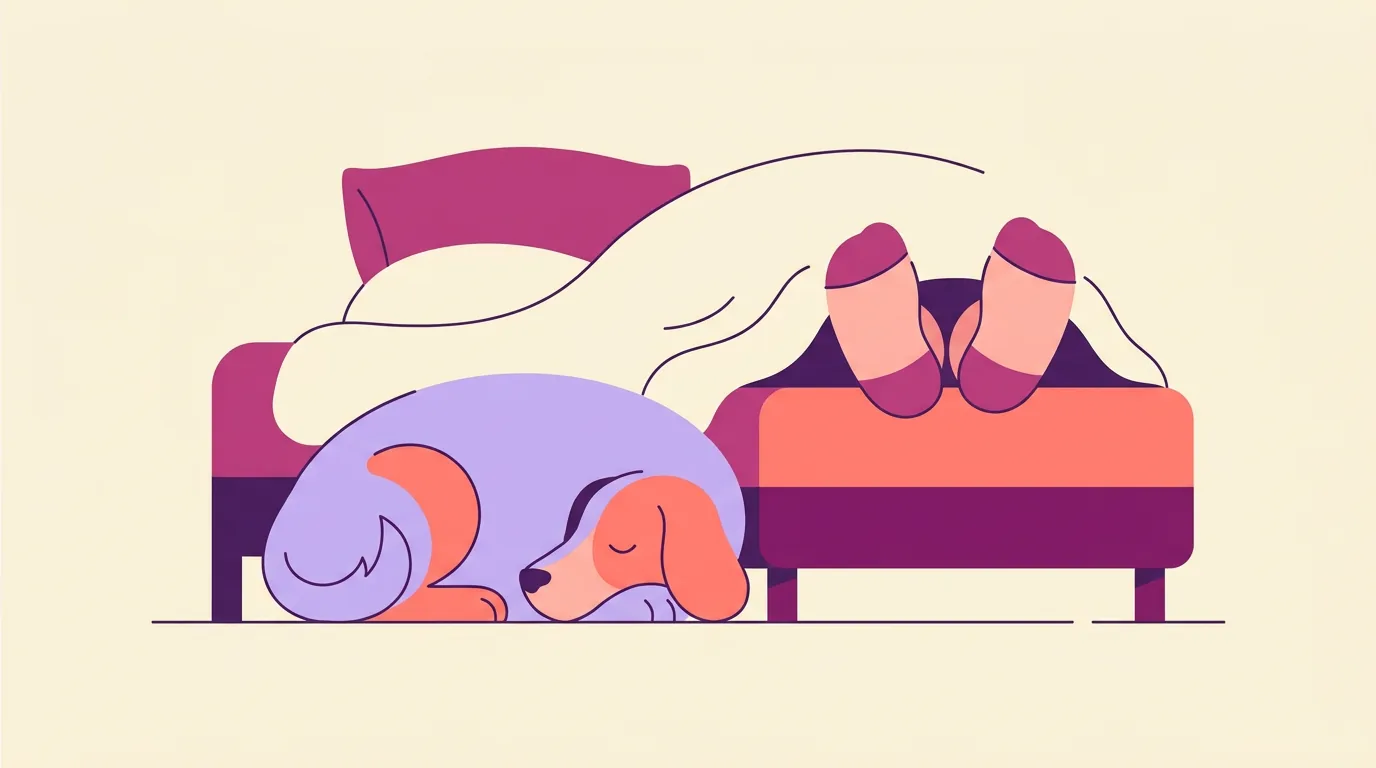
Sleeping at your feet is a pack-bonding, protective instinct — your dog stays close, keeps watch, and feels safe near your scent and warmth, while still claiming a comfortable spot of their own.
A dog that settles at your feet — on the bed, under the desk, across the doorway of whatever room you are in — is doing one of the most characteristic things dogs do. It is worth understanding properly, because the popular explanation for it is wrong.
It is not about dominance or protection
Two stories circulate. One says the dog is guarding you. The other says it is asserting rank by controlling your movement. Neither holds up.
The dominance version comes from an outdated model of dog social behaviour built on studies of captive wolves — work that has since been substantially revised by the researchers who originally produced it. Dogs are not running a rank calculation when they choose where to lie down.
The guarding version is closer to something real but overstates it. Some dogs do orient toward doorways, and a few genuinely do guard. But the everyday version of feet-sleeping in a relaxed dog is far better explained by something simpler.
Dogs are built to stay with their group
Dogs are an obligate social species, and domestication amplified their orientation toward humans specifically. Resting in contact with the group is the default state, not a special behaviour. Your feet are simply the part of you that is available at floor level.
The AKC's guidance on why dogs shadow their owners frames it the same way: this is baseline social behaviour with genetic roots, not something a dog decides to do for a reason.
- Contact and reassurance. Physical proximity regulates how dogs feel, in the same way leaning does.
- Monitoring. Lying at your feet means the dog knows immediately when you stand up — which matters, because you standing up predicts almost everything interesting.
- Warmth. Under a desk or duvet, your feet are a heat source.
- Habit and reinforcement. It has been comfortable and uneventful thousands of times.
- Breed. Herding and companion breeds were selected for close, continuous handler orientation.
Bed versus floor
If your dog sleeps at your feet on the bed, the AKC's position is that for a well-adjusted, well-behaved dog it is very unlikely to cause anything except a happier dog and a stronger bond. Surveys suggest a large share of owners — close to half — let their dog sleep in their bed.
Reported downsides are practical rather than behavioural: disturbed sleep, allergen exposure, and difficulty if a partner objects. There is also research interest in the idea that co-sleeping with a pet has some benefits for the human, though the evidence is modest and mostly about perceived comfort and companionship rather than measured sleep quality.
If you want the bed back
Give the dog a genuinely better bed, placed where it can still see you — most dogs will take a supportive orthopaedic bed beside your bed over a duvet corner, especially older dogs whose joints prefer firm support. Reward settling there rather than blocking the bedroom, and be consistent: intermittent access is what makes a dog persistent.
When it is anxiety rather than companionship
Feet-sleeping alone is not a warning sign. What matters is whether your dog can also be apart from you.
Veterinary sources describe separation anxiety as dogs that are overly attached or dependent on family members and become extremely anxious when separated. Most such dogs do follow their owners room to room — but the following is a marker, not the disorder. The disorder shows up in your absence: sustained vocalising, destruction focused around doors and exits, or house soiling in an otherwise reliably trained dog.
If your dog sleeps at your feet all evening and then settles calmly when you leave the house, you have a companionable dog. If it cannot be out of contact without distress, that is worth addressing properly.
Signals worth a vet appointment
New feet-sleeping in a dog that previously chose its own space can be about comfort rather than affection — dogs seek proximity when they are in pain, anxious, or losing hearing or sight. Get a check if it comes with difficulty rising, reluctance to use stairs, restlessness at night, panting without exertion, or disorientation. In older dogs, arthritis and cognitive dysfunction both change sleeping habits.
Gear that actually helps
Hand-picked for this behavior. We may earn a small commission — at no cost to you.
Frequently asked
Why does my dog sleep at my feet?
Dogs are an obligate social species selected for close orientation to people, so resting in contact with their group is the default. Your feet are the part of you available at floor level. Warmth, monitoring when you stand up, and simple habit all add to it.
Is my dog guarding me when it sleeps at my feet?
Usually not. Some dogs orient toward doorways and a few genuinely guard, but relaxed feet-sleeping is far better explained by ordinary social contact. The dominance version of this story comes from an outdated captive-wolf model that has since been substantially revised.
Should I let my dog sleep on my bed?
For a well-adjusted, well-behaved dog it is very unlikely to cause anything but a happier dog and a stronger bond, and close to half of owners do it. The real downsides are practical — disturbed sleep, allergens, and whether a partner minds.
Is sleeping at my feet a sign of separation anxiety?
Not on its own. What matters is whether your dog can be apart from you. Separation anxiety shows up in your absence as sustained vocalising, destruction around doors and exits, or house soiling in an otherwise trained dog.
How do I get my dog off the bed?
Provide a genuinely better alternative near your bed — most dogs, especially older ones, prefer a supportive orthopaedic bed to a duvet corner. Reward settling there rather than blocking the room, and be consistent, because intermittent access is what creates persistence.
My dog started sleeping at my feet recently. Why?
A change is worth noting. Dogs seek proximity when in pain, anxious, or losing hearing or vision. Get a vet check if it comes with difficulty rising, reluctance on stairs, night-time restlessness, panting without exertion or disorientation.
Sources
Every claim on this page is checked against published veterinary and animal-behaviour research. Here’s where it comes from.
- 1Should I Let My Dog Sleep With Me? — American Kennel Club
- 2Study: Sleeping With Pets May Be Beneficial — American Kennel Club
- 3Why Does My Dog Follow Me Everywhere? It's in Their Genes — American Kennel Club
- 4Separation Anxiety in Dogs — VCA Animal Hospitals
Keep exploring
Why Does My Dog Sleep on Top of Me?
All of them, right on top of you. It’s not about the comfy spot — it’s about being as close to you as possible.
Why Does My Dog Sleep Between My Legs?
Your dog wedges into the gap between your legs every night. It’s den instinct meets pure devotion.
Why Does My Dog Sleep with His Tongue Out?
Tongue out, totally zonked — it’s one of the cutest dog things, and it means they’re blissfully relaxed.
 🐶 Dog Mystery
Why Does My Dog Lay on Me? Warmth, Safety & “You’re My Person”
All 60 pounds of them, right on your lap. It’s not (just) about the comfy spot — it’s about you.
 🐶 Dog Mystery
Why Does My Dog Follow Me to the Bathroom? No Privacy in a Pack
Closed doors are no match for a devoted dog. Here’s why your bathroom has a furry chaperone.
 🐶 Dog Mystery
Why Does My Dog Sit on My Feet? Closeness, Comfort & Claiming You
Plopping right onto your feet isn’t your dog being bossy — it’s one of the sweeter things they do. Here’s the real meaning.