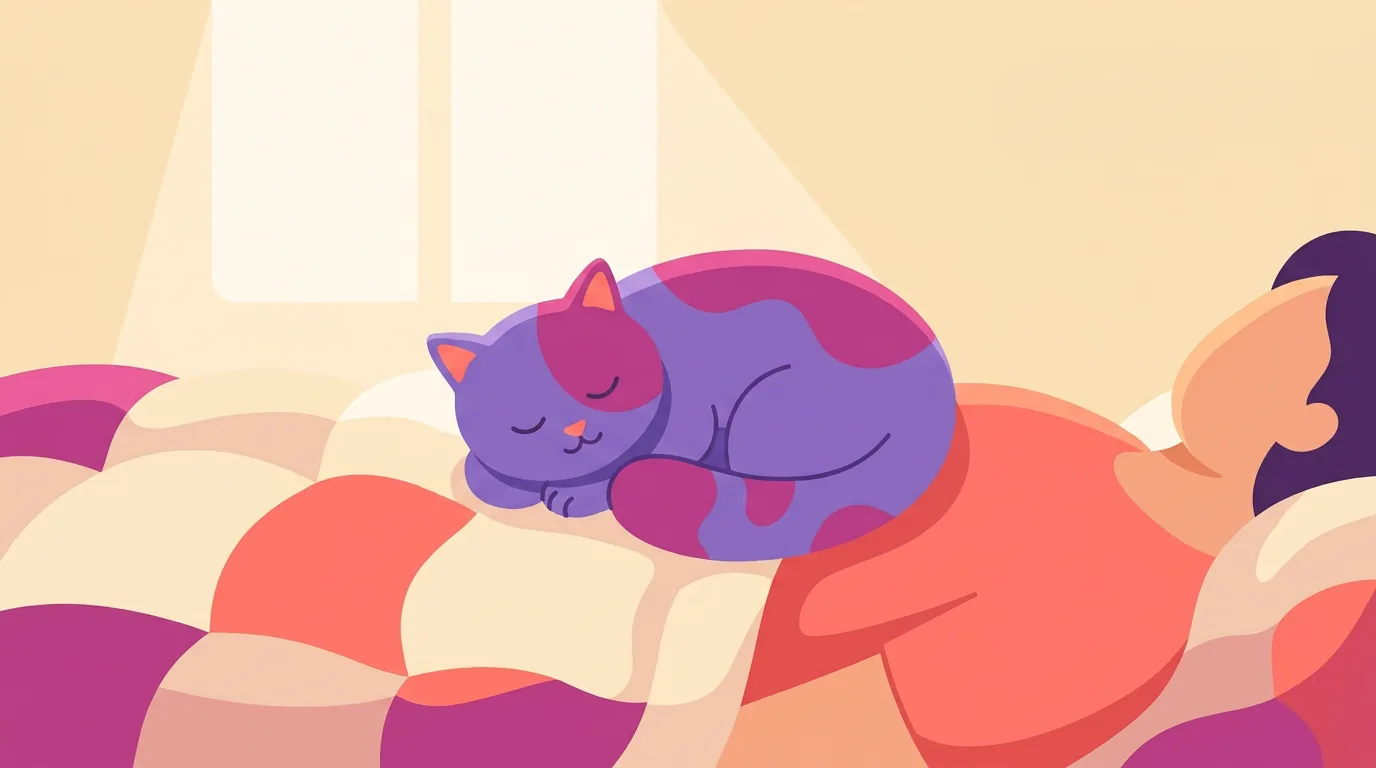
 🐱 Cat Mystery
The short answer
Your chest is warm, it rises and falls with your breathing, and it carries your heartbeat and scent. For a cat, that combination signals total safety — and it’s a deep sign of trust and bonding.
A cat on your chest is the most contact-heavy sleeping position available to it, and cats do not choose it casually. Three things make your chest specifically attractive, and one of them is genuinely interesting.
Warmth, and the rhythm underneath
Your chest is warm, broad and slightly concave when you lie on your back — close to an ideal cat-shaped platform. But the part owners underestimate is the movement: the steady rise and fall of breathing, and the heartbeat underneath it.
Kittens spend their first weeks pressed against their mother's chest and abdomen, where breathing and heartbeat are the constant background to warmth and food. Those rhythms are laid down alongside safety at the most formative point of a cat's life. An adult cat settling on a breathing chest is returning to a very old pattern.
Scent and social bonding
Cats build group identity through shared scent, and your chest and neck carry a strong personal signature. A cat sleeping there both absorbs your scent and deposits its own — the same mechanism behind cheek-rubbing and kneading.
Feline social research consistently finds affiliative behaviours like sleeping in contact concentrated among individuals with established bonds. This is not a position cats take with someone they are unsure of.
The trust element is real
Sleeping is when an animal is most vulnerable, and cats manage that vulnerability carefully — choosing elevated spots, keeping exits available, sleeping lightly. A cat that goes to sleep on your chest has given up almost all of that: it is on an unstable surface, facing away from the room, with no quick exit.
That is worth taking as the compliment it is. Whatever else is going on — warmth, comfort, habit — a cat only sleeps like that where it feels safe.
When the purring keeps you awake
Chest-sleeping cats purr more than most, because the position is associated with deep contentment. If it is disrupting your sleep, do not push the cat off mid-sleep — wait for it to shift naturally, then move it. Better still, place a warm blanket or a self-warming bed beside you at chest height; cats will reliably trade a moving surface for a warmer, stiller one.
The health signals worth knowing
Two different things are worth separating here.
First, some cats seek close contact more when they are unwell or in pain. A cat that has never been a chest-sleeper and suddenly becomes one — particularly an older cat, and particularly alongside weight change, increased thirst, night vocalising or reduced grooming — is worth a vet appointment. In senior cats, hyperthyroidism, high blood pressure, arthritis and cognitive dysfunction all change contact-seeking behaviour.
Second, and separately, having a cat on your chest is not advisable for everyone. Anyone with a cat allergy, asthma, or a respiratory condition will find chest contact the worst possible position for allergen exposure. The same applies around infants — cats should not sleep in a cot or on a baby's chest, for straightforward safety reasons rather than any of the old folklore.
Get a check if it came with other changes
New, insistent contact-seeking in an adult cat, especially with weight loss, increased thirst or urination, appetite change, night yowling, reduced grooming or reluctance to jump, warrants a veterinary appointment. Cats mask illness well, and a change in social behaviour is frequently the first thing owners notice.
Should you allow it?
For most people, yes — it is normal, it is a genuine indicator that your cat feels safe with you, and there is no behavioural downside. The dominance-flavoured advice that allowing cats onto beds and chests causes behaviour problems has no support behind it.
If you would rather not, redirect rather than refuse. Lifting a cat off and putting it down elsewhere with a warm blanket works far better than pushing it away, which most cats simply treat as an invitation to try again in ten minutes.
Gear that actually helps
Hand-picked for this behavior. We may earn a small commission — at no cost to you.
Frequently asked
Why does my cat sleep on my chest?
Warmth, a broad stable platform, and the rise and fall of your breathing with the heartbeat underneath — rhythms laid down alongside safety when kittens sleep pressed against their mother. Your chest and neck also carry a strong personal scent, which cats use to build shared group identity.
Does a cat sleeping on my chest mean it trusts me?
Yes, meaningfully. Sleeping is when cats are most vulnerable and they normally manage that carefully — elevated spots, clear exits, light sleep. A cat asleep on your chest has given up all of that, which it only does where it feels safe.
Is it safe to let my cat sleep on my chest?
For most healthy adults, yes. Avoid it if you have a cat allergy, asthma or a respiratory condition, as chest contact is the worst position for allergen exposure. Cats should never sleep in a cot or on a baby's chest.
Why does my cat purr so much when lying on my chest?
The position is strongly associated with contentment, and chest-sleeping cats tend to purr more than they do elsewhere. It generally indicates deep relaxation rather than a request for anything.
My cat suddenly started sleeping on my chest. Is something wrong?
Possibly. Cats often seek closer contact when unwell or in pain. If the change is sudden — especially in an older cat, or alongside weight change, increased thirst, night vocalising or reduced grooming — book a vet check.
Will letting my cat sleep on me cause behaviour problems?
No. That advice comes from dominance-based thinking that has no support behind it. Allowing a cat onto your bed or chest does not cause behavioural problems in an otherwise well-adjusted cat.
Sources
Every claim on this page is checked against published veterinary and animal-behaviour research. Here’s where it comes from.
- 1Social organization in the cat: a modern understanding — Journal of Feline Medicine and Surgery (via PubMed Central)
- 2Influence of familiarity and relatedness on proximity and allogrooming in domestic cats — Curtis, Knowles & Crowell-Davis, via PubMed
- 3The Special Needs of the Senior Cat — Cornell Feline Health Center
Keep exploring
Why Does My Cat Sleep on My Pillow?
Your cat has claimed your pillow as their own. It’s a bigger compliment than it seems.
Why Does My Cat Stare at Me While I Sleep?
You wake up to two eyes locked on you. Creepy? Actually, it’s mostly love (and breakfast hopes).
Why Does My Cat Sleep in Weird Positions?
Folded like a pretzel or sprawled belly-up — your cat’s weird sleep poses actually mean something.
 🐱 Cat Mystery
Why Does My Cat Sleep So Much? Inside the 16-Hour Nap
Your cat is a professional napper, and there’s nothing lazy about it. Here’s the biology behind all that beauty sleep.
 🐱 Cat Mystery
Why Does My Cat Sleep at My Feet? The Sweet Spot, Explained
Not on your chest, not across the room — your feet. There’s a surprisingly clever logic to your cat’s favorite sleeping spot.
Why Does My Cat Sit on My Chest? The Best Seat in the House
You lie down and — thump — there’s a cat on your chest, staring into your soul. Here’s what they’re after.