The short answer
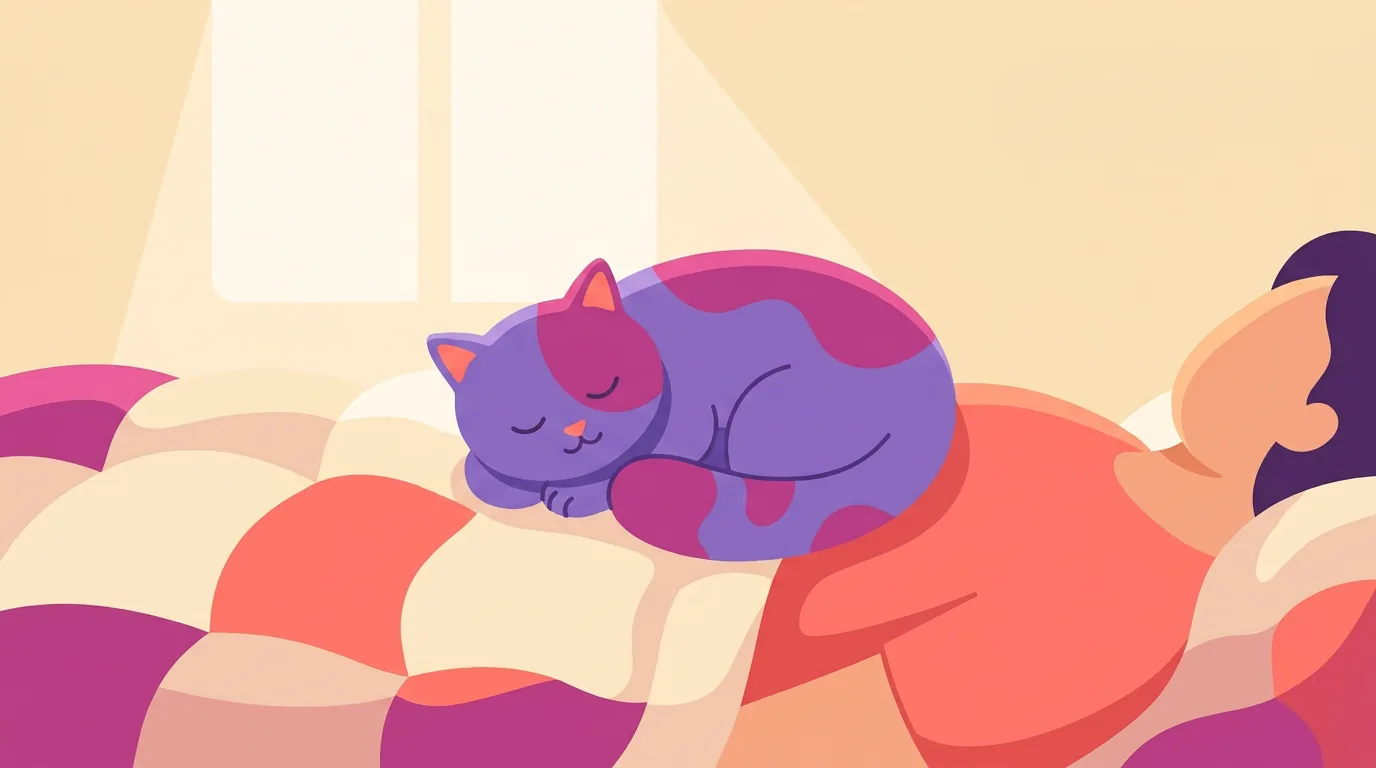
Your chest is warm, rises gently with your breathing, and carries your heartbeat and scent — a deeply comforting combo. Sitting on your chest is your cat seeking closeness, warmth, attention, and the best spot of all: you.
A cat on your chest while you are awake is a different proposition from one that settles there to sleep. It is close-range, face-to-face, and usually accompanied by direct eye contact — which for a cat is a deliberate, slightly loaded thing to do.
Why the chest
Physically it is a good platform: warm, broad, and slightly concave when you lie on your back. But there is more to it than furniture. Your chest carries the rise and fall of breathing and the heartbeat underneath — rhythms a kitten spends its first weeks pressed against, alongside warmth and food.
It also puts the cat at your face height. Cats direct social behaviour at heads and necks, and being level with your face is where head-butting, cheek-rubbing and grooming naturally happen.
It is usually a request
This is where chest-sitting differs from chest-sleeping. A cat that climbs on and settles is being comfortable. A cat that climbs on, sits upright, and looks at you is asking for something.
- Attention. The most common. You are horizontal, still and not holding a phone — from the cat's perspective, finally available.
- Food. Especially if it happens at consistent times, or if the cat then gets up and walks toward the kitchen.
- Scent exchange. Head-butting and cheek-rubbing at face height deposit scent from the glands on the cheeks and forehead, folding you into the group smell.
- Warmth. Straightforward, and often enough on its own.
- Waking you deliberately. Cats are crepuscular, and a cat that wants breakfast has learned that sitting on a chest works better than meowing from the floor.
The trust part is real
Research on feline social structure consistently finds that proximity and physical contact are the main currency of cat relationships, and that affiliative behaviours concentrate among individuals with established bonds rather than being distributed indiscriminately.
Sitting on a person's chest is about as much contact and as little escape route as a cat will accept. It is not a position cats take with someone they are unsure of, whatever else is motivating it.
The slow blink works best here
Face-to-face at close range is exactly the situation the slow blink evolved for. Meet your cat's gaze, narrow your eyes slightly and close them for about a second. Many cats return it. It is one of the few reliable ways to actively signal to a cat that you are not a threat, and it is particularly useful with cats that are still settling into a home.
The 5am version
If the chest-sitting happens mainly before dawn, you are dealing with an activity-cycle problem rather than an affection one. Cats are most active around dawn and dusk, and an indoor cat that has slept through a quiet house all day arrives at 5am fully rested.
The fix happens the night before, not at 5am. A genuine wand-toy play session run until the cat is actually tired — often 15 to 20 minutes rather than a token five — followed immediately by the largest meal of the day, mimics the hunt-eat-groom-sleep sequence cats are built around. A timed automatic feeder set for early morning removes the incentive to wake you at all.
Responding to the 5am version, even occasionally, is what makes it durable. Intermittent reinforcement is the hardest pattern to extinguish, which is why owners who 'only sometimes' get up report the behaviour getting worse rather than better.
When to pay attention
Book a vet check if the behaviour changed
New, insistent contact-seeking in an adult cat is worth investigating, particularly alongside increased vocalisation, weight loss, increased thirst or urination, appetite change, reduced grooming, or reluctance to jump. Cats seek proximity when unwell, and in cats over about seven, hyperthyroidism, high blood pressure, arthritis and cognitive dysfunction all present with changes in social behaviour. Hyperthyroidism in particular is common, presents exactly this way, and is diagnosed with a straightforward blood test.
Separately, and practically: chest contact is the worst position for allergen exposure. If anyone in the household has asthma or a cat allergy, this is the specific behaviour to redirect — and cats should never sleep on an infant's chest or in a cot.
Gear that actually helps
Hand-picked for this behavior. We may earn a small commission — at no cost to you.
Frequently asked
Why does my cat sit on my chest?
It is warm, broad and stable, it carries your breathing and heartbeat — rhythms kittens spend their first weeks against — and it puts the cat at your face height, where cats naturally direct head-butting and cheek-rubbing. Most upright chest-sitting is also a request for something.
Is my cat sitting on my chest a sign of trust?
Yes. It involves maximum contact and almost no escape route, and research finds affiliative contact concentrated among cats with established bonds rather than distributed indiscriminately. It is not a position cats take with someone they are unsure of.
Why does my cat sit on my chest and stare at me?
It is usually asking for something — attention, food, or a door. Return a slow blink rather than a hard stare: narrow your eyes and close them for about a second. Many cats reciprocate, and it signals that you are not a threat.
How do I stop my cat waking me at 5am?
Fix the night before. Play with a wand toy until your cat is genuinely tired — often 15 to 20 minutes — then feed the largest meal of the day immediately after. Add a timed feeder for early morning. Never respond occasionally; intermittent reinforcement makes it far more persistent.
Is it safe to let my cat sit on my chest?
For most healthy adults, yes. It is the worst position for allergen exposure though, so redirect it if anyone in the household has asthma or a cat allergy. Cats should never sleep on an infant's chest or in a cot.
My cat suddenly started doing this. Should I worry?
A sudden change is worth a vet check, especially alongside increased vocalisation, weight loss, increased thirst, appetite change or reluctance to jump. Hyperthyroidism is common in middle-aged and older cats, presents this way, and is diagnosed with a simple blood test.
Sources
Every claim on this page is checked against published veterinary and animal-behaviour research. Here’s where it comes from.
- 1Social organization in the cat: a modern understanding — Journal of Feline Medicine and Surgery (via PubMed Central)
- 2Influence of familiarity and relatedness on proximity and allogrooming in domestic cats — Curtis, Knowles & Crowell-Davis, via PubMed
- 3The Special Needs of the Senior Cat — Cornell Feline Health Center
Keep exploring
Why Does My Cat Sit by the Door?
Your cat posted up at the front door like a tiny doorman? Here’s what they’re actually doing.
Why Does My Cat Sit on My Laptop?
Every time you open your laptop, a cat appears on the keyboard. Here’s the (very strategic) reason.
 🐱 Cat Mystery
Why Does My Cat Sleep on My Chest? It’s More Than Just Warmth
It’s not just because you’re warm. Your cat is choosing the single safest spot in their world — you. Here’s why.
Why Does My Cat Follow Me to the Bathroom?
No privacy with a cat in the house. Here’s why the bathroom always comes with a feline chaperone.
Why Does My Cat Lay on My Clothes?
Fresh laundry, worn hoodie, it doesn’t matter — your cat will claim it. Here’s the cozy reason why.
Why Does My Cat Sleep on My Pillow?
Your cat has claimed your pillow as their own. It’s a bigger compliment than it seems.