 🐱 Cat Mystery
The short answer
Kneading is a leftover kitten instinct that now means comfort, ownership, and pure contentment. When your cat kneads you, they’re telling you they feel safe — and that you’re ‘theirs.’
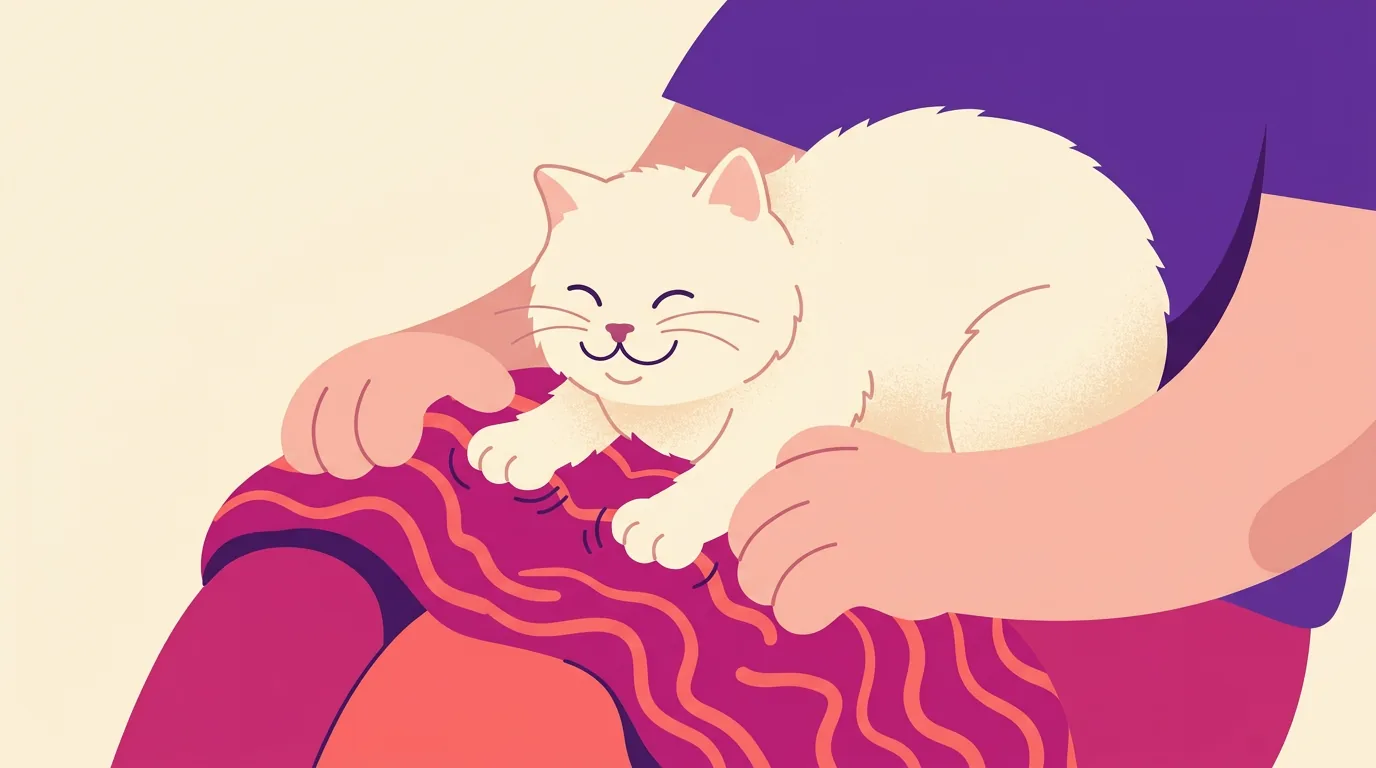
If your cat plants their paws on your lap and starts pushing in and out like they are working dough, you are watching one of the oldest behaviours a cat has. It starts in the first hours of life and, in a lot of cats, never fully stops. Owners call it making biscuits. Behaviourists call it kneading, and it is one of the clearest windows you get into how your cat actually feels about you.
It starts before their eyes are open
A newborn kitten is blind, deaf and almost immobile, but it can knead. Pressing alternate front paws against the mother's mammary glands stimulates milk letdown, so the kitten that kneads effectively is the kitten that eats. The motion is hardwired and it is rewarded, immediately and repeatedly, at the single most formative moment of a cat's life.
That pairing matters more than the mechanics. For those first weeks, kneading is welded to warmth, a full stomach, and safety. The behaviour does not need to keep serving a nutritional purpose to persist — it survives because the emotional association survives. When an adult cat kneads your leg, they are not confused about whether you are their mother. They are reaching for a motion that has meant safe for their entire life.
Why adults keep doing it
Weaned kittens should, in theory, drop the behaviour. Plenty do. But a large share of adult cats keep kneading, and the reasons stack rather than compete. Most kneading sessions you witness are two or three of these at once:
- Self-soothing. Kneading is rhythmic and repetitive, and cats reliably perform it when relaxed rather than alert. It appears in the wind-down before sleep far more than at any other time.
- Scent-marking. Cats have scent glands in the pads of their paws. Pressing those pads into a surface transfers scent, which is why kneading so often happens on the one blanket, chair or person a cat treats as theirs.
- Nest-building. Wild and big cats paw at grass and leaves to flatten a resting spot before lying down. The domestic version is aimed at a duvet that needs no flattening, but the motor pattern is unchanged.
- Bond signalling. Cats overwhelmingly knead the person they spend the most time in contact with — and, per the research on feline social structure, physical proximity is the main currency of cat relationships.
- Hormonal cycling. Unspayed females often knead noticeably more around oestrus, alongside other restless, affection-seeking behaviour.
The scent-marking point is the one most owners miss, and it reframes the whole behaviour. Cats do not carve territory the way dogs do. They build a shared scent profile and treat everything inside it as safe. Kneading you is an act of inclusion — you are being folded into the group scent, the same way a cat rubs its cheek along a doorframe.
Why it is almost always you and not your partner
This is the single most common follow-up question, and the answer is rarely flattering to whoever is asking. Cats knead the person who is most predictable, not the person who is most affectionate. Research on domestic cat social behaviour consistently finds that proximity and familiarity — time spent quietly co-located — predict affiliative behaviour better than active attention does.
In practice, cats tend to knead the household member who sits still in the same chair at the same time each evening, who does not initiate contact, and who does not move much once the cat settles. If your cat picks someone else, it usually means that person is a more reliable surface, not a more loved one.
Make it comfortable instead of stopping it
Keep a folded throw where your cat likes to settle and pull it onto your lap before they arrive. Claws land in fabric instead of skin, and you keep the behaviour. Trimming the front nails every two to three weeks removes most of the sting. Never push the cat off or scold mid-knead — you are punishing the clearest trust signal they have.
What the newest research adds
A 2026 video study of cats living in pairs, run by researchers at Ghent University and the University of Lincoln, looked closely at allogrooming — the licking cats direct at each other, kneading's close cousin. The finding that surprised people was that these contact behaviours are not purely affectionate. A meaningful share were followed by tension: a stiffening, a swat, a threat display.
The useful takeaway is not that your cat secretly dislikes you. It is that close-contact behaviours in cats are about managing a relationship, not just celebrating one. Cats use contact to negotiate space and status as well as to bond. That is why kneading sometimes shifts abruptly into a nip, and why reading the rest of the body — tail, ears, pupils — matters more than reading the paws alone.
Reading a kneading session correctly
Content kneading is slow and loose. The eyes are half-shut or doing the slow blink, the tail is still or gently curled, the ears face forward, and purring is common. The cat may drool slightly — an involuntary carryover from nursing, and a sign of deep relaxation rather than a problem.
Kneading that is fast, tense and frantic is different. Paired with flattened ears, a twitching or thumping tail, dilated pupils, or over-grooming elsewhere on the body, it points to arousal or anxiety rather than contentment. That pattern is worth attention: more structured play, more predictable routine, and if it is a new change, a conversation with your vet.
When kneading is worth a vet visit
Kneading itself is not a medical sign. But a sudden, marked change in it — a cat that never kneaded starting compulsively, or one that always did stopping entirely — is worth mentioning at your next appointment, particularly alongside weight change, appetite change, hiding, or new night-time vocalising. Behaviour change is often the earliest sign of pain or illness in cats, and it is the part owners notice first.
Should you try to stop it?
Generally, no. Kneading is normal, self-reinforcing and harmless, and the only real cost is claws. Punishment is a poor tool here: it does not extinguish an instinctive comfort behaviour, and it does damage a relationship the cat is actively trying to strengthen. Redirect the surface, not the behaviour — a blanket, a dedicated cushion, a cat bed placed where you sit.
The one thing genuinely worth changing is timing. If your cat only kneads at 3am on your chest, the fix is not suppression but scheduling: a real play session and a meal in the hour before bed shifts a cat's activity cycle far more effectively than any correction will.
Gear that actually helps
Hand-picked for this behavior. We may earn a small commission — at no cost to you.
Frequently asked
Why does my cat knead me but not my partner?
Usually because you are the more predictable resting surface, not because you are the favourite. Cats form affiliative bonds around proximity and routine — the person who sits in the same spot, stays still, and does not initiate contact tends to get kneaded most.
Why does my cat drool when kneading?
It is a leftover from nursing, when kneading and milk arrived together. Mild drooling during a relaxed kneading session is normal. Drooling outside of that context — especially with bad breath, pawing at the mouth, or reduced appetite — should be checked by a vet, as it often points to dental disease.
Why does kneading sometimes turn into biting?
Contact behaviours in cats manage relationships as well as express affection, and repetitive stroking can tip a relaxed cat into overstimulation. Watch for the warning signs — tail lashing, skin twitching, ears rotating back, pupils widening — and stop petting before the nip rather than after.
Do male and female cats knead differently?
Not meaningfully. Kneading is not sex-linked. Unspayed females may knead more around their cycle, but neutered cats of both sexes knead at broadly similar rates.
My cat has never kneaded. Is something wrong?
No. Kneading frequency varies enormously between individuals, and some cats — often those weaned very early or very late — never knead at all. What matters is change over time, not the baseline.
Why does my cat knead blankets instead of me?
Soft, textured fabric holds scent well and gives better resistance underfoot than skin. Many cats simply prefer the material. It carries the same meaning as kneading a person.
Sources
Every claim on this page is checked against published veterinary and animal-behaviour research. Here’s where it comes from.
- 1Social organization in the cat: a modern understanding — Journal of Feline Medicine and Surgery (via PubMed Central)
- 2Influence of familiarity and relatedness on proximity and allogrooming in domestic cats — Curtis, Knowles & Crowell-Davis, via PubMed
- 3Unravelling feline social dynamics — a video-based observational study on allogrooming in domestic cats — Van Belle et al., Applied Animal Behaviour Science (2026)
- 4The Science Behind Cat Kneading: Understanding Feline Behavior — The International Cat Association (TICA)
Keep exploring
Why Does My Cat Knead Blankets? Making Biscuits, Explained
Paws pressing rhythmically into a soft blanket — “making biscuits.” It’s pure cozy instinct. Here’s why.
Why Does My Cat Follow Me to the Bathroom?
No privacy with a cat in the house. Here’s why the bathroom always comes with a feline chaperone.
Why Does My Cat Lay on My Clothes?
Fresh laundry, worn hoodie, it doesn’t matter — your cat will claim it. Here’s the cozy reason why.
Why Does My Cat Sleep on My Pillow?
Your cat has claimed your pillow as their own. It’s a bigger compliment than it seems.
Why Does My Cat Lick the Wall?
Tongue to the wall? It’s odd but common — and here’s how to tell harmless curiosity from a red flag.
Why Does My Cat Chatter at Birds?
Window open, bird outside, and your cat goes “ek-ek-ek.” Here’s what that funny chatter really means.