 🐱 Cat Mystery
The short answer
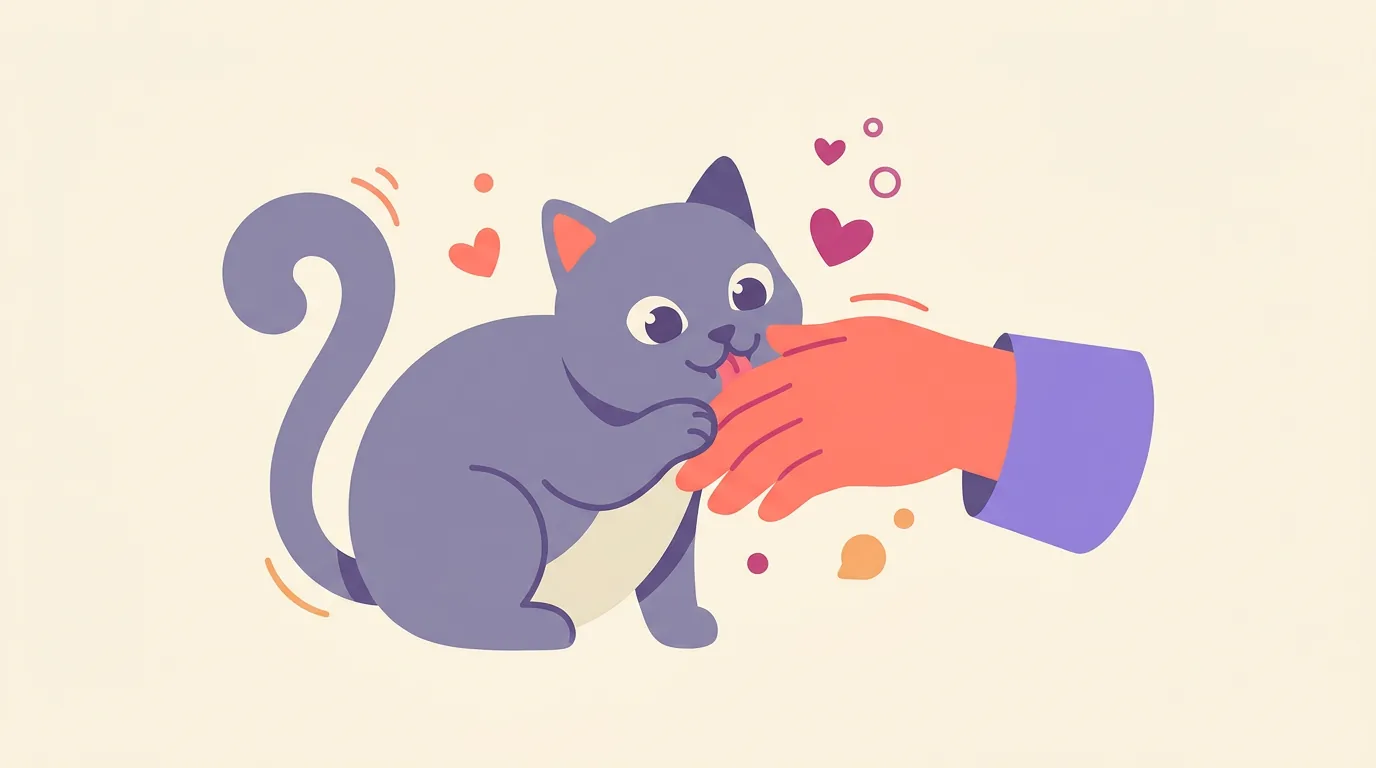
Biting then licking is usually ‘love biting’ or grooming — your cat sees you as family. Sometimes it means overstimulation: a gentle ‘that’s enough petting’ followed by an apology lick.
The sequence is always the same and always confusing. Your cat is on your lap, purring, being stroked. Then teeth. Then, a second later, the same cat is licking the spot it just bit. Owners read this as an apology. It is not — but the real explanation is more interesting and considerably more useful.
The bite is almost always overstimulation
Veterinary behaviour resources have a name for this: petting-induced aggression. It describes a cat that has been enjoying contact, reaches a threshold, and switches abruptly to wanting the contact to stop. The bite is a full stop, not an attack.
The mechanism is straightforward. Repeated stroking over the same area produces steadily building arousal. Cats have a much lower tolerance for sustained repetitive touch than dogs or humans do, and individual thresholds vary enormously — some cats tolerate twenty minutes, others ninety seconds. Once the threshold is crossed, the cat uses the most efficient tool available to end it.
Crucially, these bites are usually inhibited. A cat that genuinely wanted to injure you would not stop at a pinch. What you are getting is a deliberately measured signal.
So what is the lick?
Not remorse. Cats do not appear to run the kind of social-repair apology behaviour that would require. The likelier explanations are simpler and they overlap.
- The grooming sequence resumed. Cats groom each other with teeth and tongue together — nibble, then lick. Between cats this is one continuous behaviour, and you are simply feeling the teeth part more than a cat would.
- Tension management. The 2026 Ghent and Lincoln allogrooming study found grooming frequently sits adjacent to low-level conflict between cats, functioning as appeasement or as a soft assertion of status. A lick following a bite fits that pattern.
- Self-soothing after arousal. Cats commonly groom after any spike in arousal — a startle, a scuffle, a near-miss. Grooming is how a cat downshifts.
- You reacted. You flinched, yelped or moved. That is salient, and licking is a common feline response to a sudden change in a companion's state.
Reading the warning signs
The bite feels like it comes from nowhere. It does not. Cats telegraph the switch, usually two to five seconds ahead, but the signals are subtle and easy to miss while you are looking at a television.
- 1The tail starts moving — a slow lash, a thump against your leg, or a fast flick at the tip.
- 2The skin along the back or flank twitches or ripples.
- 3The ears rotate sideways or backward, flattening toward the head.
- 4The pupils dilate even though the light has not changed.
- 5The body stiffens slightly, or the head turns toward your hand.
- 6Purring stops or changes pitch.
Stop before the signal, not after it
The most effective change is also the simplest: stroke in short bursts. Three or four strokes, then pause and take your hand away. If the cat leans in or head-butts your hand, continue. If they stay neutral, stop. You are handing the cat control of the interaction, which removes the reason to bite.
Where you pet matters as much as how long
Cats are not uniformly receptive across the body. Most tolerate and enjoy contact around the head — the cheeks, under the chin, the base of the ears and along the forehead. These are the scent-gland areas cats rub against objects, and the areas other cats groom.
The belly, the base of the tail, and the full length of the back are far more variable, and the belly in particular is a common trigger. A cat rolling over and exposing its stomach is displaying comfort, not issuing an invitation to touch it. Sticking to the head and neck eliminates a large share of bites on its own.
When it is pain rather than overstimulation
There is an important exception. If bites cluster around one specific area of the body — a particular spot on the back, one hip, the base of the tail, one ear — pain becomes the more likely explanation. Cornell's guidance on feline aggression flags pain as a trigger to consider when bites occur reliably on contact with a specific region.
Arthritis is badly underdiagnosed in cats and extremely common in older ones, and dental disease produces the same picture around the head. A cat that has always tolerated being stroked and suddenly stops is giving you medical information, not behavioural information.
Get a check if the pattern changed
See a vet if the biting is new in a cat that never used to do it, if it is always in the same spot, if your cat has become reluctant to jump or is grooming less thoroughly, or if the bites have escalated from inhibited nips to real force. Also clean any bite that breaks the skin properly and see a doctor if it swells or reddens — cat bites are puncture wounds and carry a genuine infection risk.
What not to do
Do not pull your hand away sharply — fast movement triggers the predatory response and turns a nip into a grab. Go still instead, then withdraw slowly once the cat releases.
Do not punish, tap the nose, or shout. The cat asked you to stop using the only clear signal it has; punishing that teaches it that signalling does not work, and cats that learn this tend to skip the warnings and go straight to the bite. Do not use hands as toys at any age — kittens that wrestle fingers become adults who wrestle fingers, only with adult strength.
Gear that actually helps
Hand-picked for this behavior. We may earn a small commission — at no cost to you.
Frequently asked
Is my cat apologising when it licks after biting?
No — there is no good evidence cats run apology behaviour. More likely the bite and lick are two halves of one grooming sequence, or the cat is self-soothing after a spike in arousal. The 2026 allogrooming research also found grooming often sits next to low-level conflict as tension management.
Why does my cat bite me when I'm petting it?
It is usually petting-induced aggression: sustained repetitive stroking builds arousal until the cat wants it to stop, and the bite is a full stop rather than an attack. Stroke in short bursts, pause often, and let the cat ask for more.
How do I know when my cat is about to bite?
Watch the tail, skin and ears. A lashing or thumping tail, rippling skin along the back, ears rotating backward, widening pupils and a sudden stiffening all appear a few seconds before the bite. Stop at the first sign.
Should I punish my cat for biting?
No. The cat used the clearest signal it has to end contact. Punishing it teaches the cat that signalling does not work, and cats that learn this tend to stop warning and go straight to biting.
Could biting mean my cat is in pain?
Yes, especially if the bites are new or always triggered by touching one specific area. Arthritis and dental disease are both common and underdiagnosed in cats. A cat that always accepted handling and suddenly stops should be examined.
Do I need to worry about a cat bite that breaks the skin?
Take it seriously. Cat bites are deep punctures that seal over quickly and trap bacteria. Wash thoroughly with soap and water, and see a doctor if there is swelling, redness, heat or worsening pain — especially for bites to the hand.
Sources
Every claim on this page is checked against published veterinary and animal-behaviour research. Here’s where it comes from.
- 1Cat Behavior Problems — Aggression — Petting Aggression — VCA Animal Hospitals
- 2Feline Behavior Problems: Aggression — Cornell Feline Health Center
- 3Unravelling feline social dynamics — a video-based observational study on allogrooming in domestic cats — Van Belle et al., Applied Animal Behaviour Science (2026)
- 4Aggression in Cats — ASPCA
Keep exploring
Why Does My Cat Bite Me Gently? Love Bites, Decoded
A soft little nibble that doesn’t hurt? That’s your cat talking — and it’s usually sweet. Here’s the translation.
 🐱 Cat Mystery
Why Does My Cat Lick Me? Your Cat’s Sandpaper Love Language
It tickles, it’s scratchy, and it’s strangely sweet. When your cat licks you, they’re saying something important — here’s the translation.
Why Does My Cat Lick the Wall?
Tongue to the wall? It’s odd but common — and here’s how to tell harmless curiosity from a red flag.
Why Does My Cat Wink at Me? The Secret “I Love You”
When your cat slow-winks at you, they’re saying something sweet. Here’s how to read — and return — it.
 🐱 Cat Mystery
Why Does My Cat Lick My Hair? The Grooming Compliment
Waking up to a cat styling your hair with their tongue? It’s weird, it’s sweet, and it means more than you’d think.
Why Does My Cat Bite My Hair? The Quirky Grooming Habit
Little nibbles on your ponytail? It’s your cat treating your hair like family fur. Here’s the deal.