 🐱 Cat Mystery
The short answer
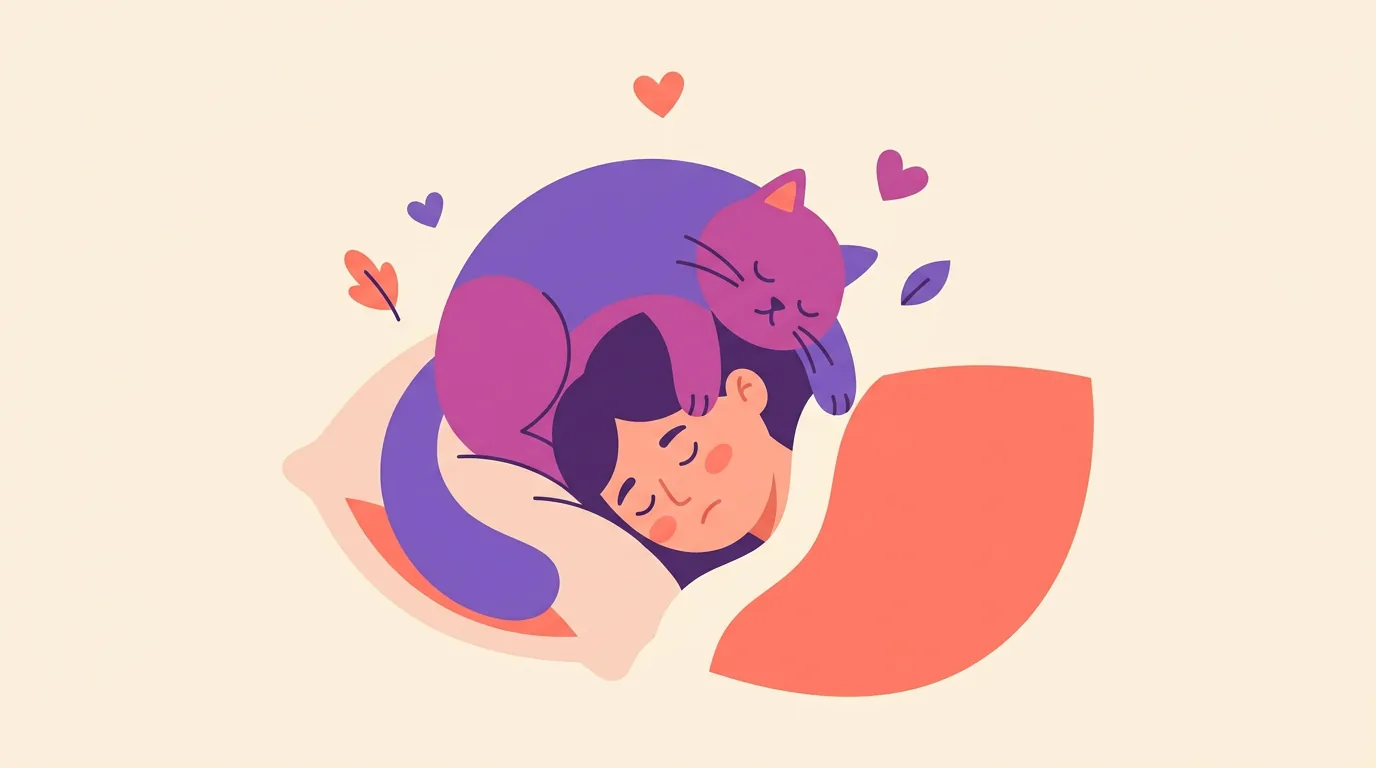
Your head is warm, mostly still, and smells strongly of you — irresistible to a bonded cat. Sleeping there is a sign of trust and comfort, drawn by radiant heat and your familiar scent on hair and pillow.
Of all the places a cat could choose, your head is the one that makes least sense to you and most sense to the cat. There are four converging reasons, and once you know them the behaviour stops looking random.
Your head is the warmest thing in the bed
Cats run a higher body temperature than we do and their thermoneutral zone — the range where they are comfortable without expending energy on staying warm — sits well above typical room temperature. They are heat-seeking almost to a fault.
Under a duvet, your head is the one part of you exposed to the air, and it radiates heat continuously. It is, quite literally, the warmest available surface that is not buried under a blanket. Add that you exhale warm air all night and the appeal becomes obvious.
It is the safest place in the bed
A sleeping cat is vulnerable, and cats choose sleeping positions accordingly. Your head does not move much. Your legs, hips and arms shift constantly through the night; your head is the most stable platform on an otherwise unpredictable surface.
This matters more than owners assume. A cat displaced three times a night by a moving knee will relocate to the one spot that stays put — and it is not making an emotional statement so much as a practical one.
Scent, and being part of the group
Research on feline social structure finds that cats maintain relationships through proximity and shared scent rather than overt display. Sleeping in contact is one of the strongest affiliative behaviours cats perform, and it is concentrated among individuals with established bonds.
Your head and hair carry the densest concentration of your personal scent. A cat sleeping against it is both taking on your smell and depositing its own, reinforcing a shared group odour. It is the same underlying mechanism as cheek-rubbing a doorframe, applied to the person it lives with.
The kitten explanation
Kittens sleep in a pile against their mother and littermates, and the position that gets the most warmth and contact is pressed against another body. Many cats simply keep the preference into adulthood, and hair is the closest available approximation to fur.
That is also why some cats knead your hair, suckle at it, or groom it while settling. Those behaviours cluster together and share an origin.
If you want your head back
Do not shut the cat out of the bedroom — a closed door usually produces yowling and makes the whole situation worse. Give the cat a better option instead: a heated or self-warming bed placed at the head end of your bed, or on a bedside table at pillow height. Cats will reliably trade a person for a warmer, more stable surface. Move it a little further away each week if you want it off the bed entirely.
When it is worth attention
Sleeping on your head is normal. What is worth noticing is a change from your cat's own pattern.
A cat that has always slept at the foot of the bed and suddenly insists on your head — particularly an older cat, and particularly with restlessness, night vocalising or disorientation — may be showing something other than affection. Cats seek proximity when they feel unwell or insecure, and in senior cats the usual candidates are hyperthyroidism, high blood pressure, declining vision or hearing, arthritis and cognitive dysfunction.
Book a check if the change was sudden
See a vet if new, insistent clinginess appears alongside weight loss, increased thirst or urination, appetite change, night-time yowling, disorientation, or reluctance to jump. Hyperthyroidism is the most common endocrine disease of cats, it mostly affects middle-aged and older animals, and it is diagnosed with a straightforward blood test.
Is it hygienic?
For most healthy adults it is fine. Practical caveats: allergen exposure is highest in the bedroom, so if anyone in the house has asthma or a cat allergy, the bedroom is the single most effective room to keep cat-free. Keep flea and worm prevention current, and if your cat goes outdoors and uses a litter tray, wash bedding more often than you otherwise would.
Beyond that, the main cost is sleep quality. If your cat is genuinely waking you every night, the fix is not tolerating it indefinitely — it is shifting the cat's activity cycle with a real play session and the largest meal of the day in the hour before you go to bed.
Gear that actually helps
Hand-picked for this behavior. We may earn a small commission — at no cost to you.
Frequently asked
Why does my cat sleep on my head specifically?
Four things converge: your head is the warmest exposed surface in the bed, it is the most stable part of a person who shifts all night, your hair carries the densest concentration of your scent, and pressing against another body replicates how kittens sleep.
Does my cat sleeping on my head mean it loves me?
Sleeping in contact is one of the strongest affiliative behaviours cats perform and is concentrated among established bonds — so it does indicate attachment. Warmth and stability are genuinely part of the motivation too, and both can be true at once.
How do I get my cat to stop sleeping on my head?
Do not shut the cat out; that usually causes yowling. Offer a better option — a heated or self-warming bed at the head end of your bed or on a bedside table at pillow height. Cats will trade a person for a warmer, more stable surface, and you can move it further away gradually.
Is it safe to let my cat sleep on my head?
For most healthy adults, yes. Keep flea and worm prevention current and wash bedding regularly. If anyone in the household has asthma or a cat allergy, keeping the bedroom cat-free is the single most effective change you can make.
My cat suddenly started sleeping on my head. Why?
A sudden change from your cat's own pattern is worth noting, especially in an older cat. Cats seek proximity when they feel unwell or insecure. If it comes with weight loss, increased thirst, night yowling or disorientation, get a vet check — hyperthyroidism presents this way and is very treatable.
Why does my cat knead or suck my hair while settling?
Those behaviours share an origin with sleeping against you: kittens knead and nurse against their mother while pressed into a warm pile, and hair is the closest available approximation to fur. It is normal and usually a sign of deep relaxation.
Sources
Every claim on this page is checked against published veterinary and animal-behaviour research. Here’s where it comes from.
- 1Social organization in the cat: a modern understanding — Journal of Feline Medicine and Surgery (via PubMed Central)
- 2Influence of familiarity and relatedness on proximity and allogrooming in domestic cats — Curtis, Knowles & Crowell-Davis, via PubMed
- 3The Special Needs of the Senior Cat — Cornell Feline Health Center
Keep exploring
Why Does My Cat Sleep on My Pillow?
Your cat has claimed your pillow as their own. It’s a bigger compliment than it seems.
 🐱 Cat Mystery
Why Does My Cat Sleep at My Feet? The Sweet Spot, Explained
Not on your chest, not across the room — your feet. There’s a surprisingly clever logic to your cat’s favorite sleeping spot.
Why Does My Cat Stare at Me While I Sleep?
You wake up to two eyes locked on you. Creepy? Actually, it’s mostly love (and breakfast hopes).
Why Does My Cat Sleep in Weird Positions?
Folded like a pretzel or sprawled belly-up — your cat’s weird sleep poses actually mean something.
 🐱 Cat Mystery
Why Does My Cat Sleep So Much? Inside the 16-Hour Nap
Your cat is a professional napper, and there’s nothing lazy about it. Here’s the biology behind all that beauty sleep.
Why Does My Cat Trill? The Happy Chirp, Explained
That cute little “brrp!” your cat makes? It’s one of their warmest, friendliest sounds. Here’s what it means.