 🐱 Cat Mystery
The short answer
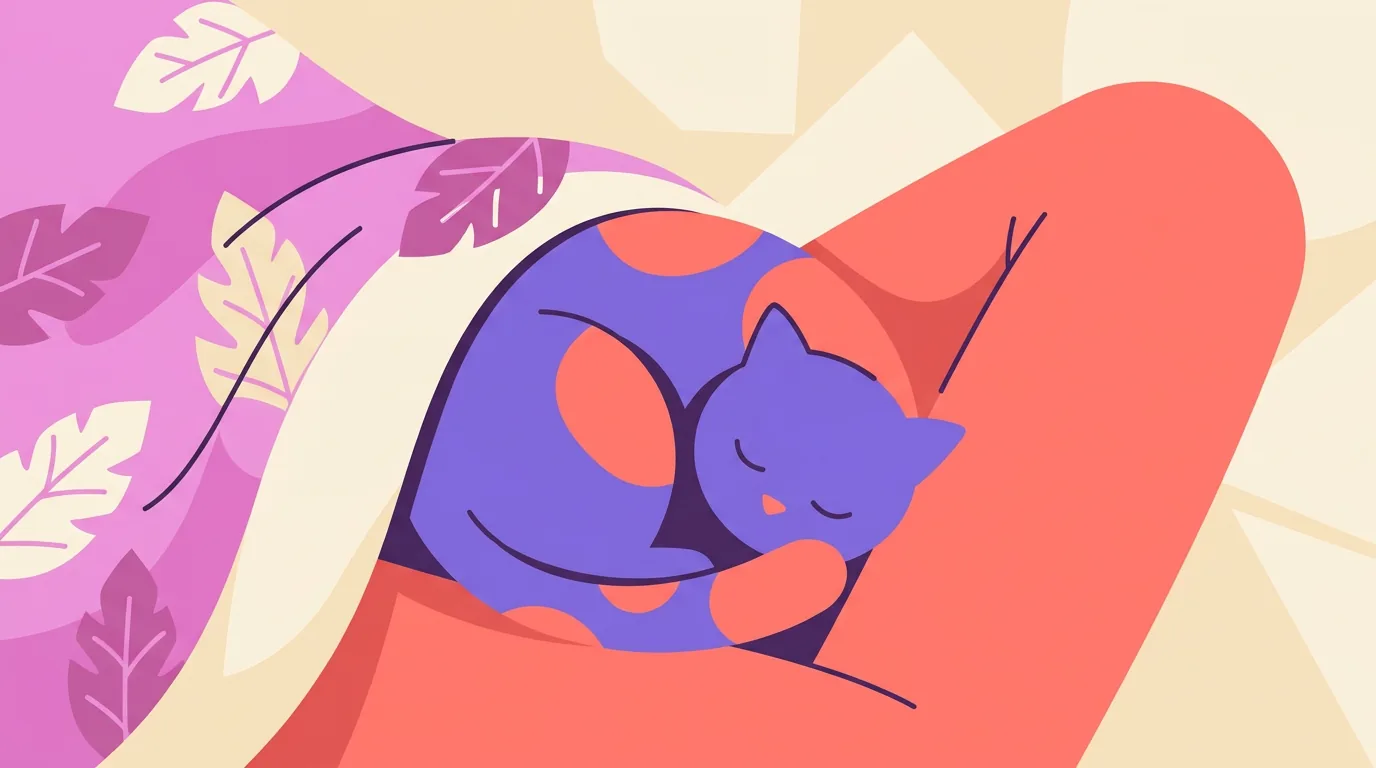
The space between your legs is a warm, enclosed “den” that feels safe and cozy, surrounds your cat with your scent, and keeps them close to you. It’s a strong trust and bonding sign.
The gap between your legs is, from a cat's point of view, close to a purpose-built bed. It is enclosed on three sides, warm on all of them, and it barely moves. Cats are not being strange when they pick it — they are picking the best available spot.
It is a den
Cats seek enclosed sleeping spots. It is the same drive behind boxes, drawers, under-bed spaces and laundry baskets: partial enclosure means fewer directions to monitor, which means deeper sleep. A cat curled between your legs has walls on three sides and only one open approach.
This is why the behaviour intensifies in cats that are new to a home, nervous around visitors, or living with other pets. The more a cat feels it needs to keep track of, the more attractive an enclosed spot becomes.
Heat from three directions
Cats are comfortable at temperatures most people find too warm, and they are efficient at finding the warmest microclimate in a room. The space between your legs is warmed on both sides by your body and above by the duvet, and the enclosure traps that heat rather than letting it escape.
It is measurably warmer than the surface of the bed beside you, which is exactly why the cat is there and not six inches to the left.
Stability
Legs are among the least mobile parts of a sleeping person. Arms move, torsos roll, heads turn — legs mostly stay put for long stretches. For an animal that will relocate rather than tolerate repeated disturbance, that matters more than it sounds.
It also explains the frustrating part of the arrangement: once a cat has settled there, moving your legs feels impossible. Many owners report sleeping in genuinely uncomfortable positions rather than disturb the cat, which is worth naming as a real cost rather than a joke.
And the bond
Feline social behaviour is built on proximity and shared scent rather than display. Sleeping in contact is one of the clearest affiliative behaviours cats have, and research finds it concentrated among individuals with established relationships rather than distributed indiscriminately.
So the position combines all four motivations at once: enclosure, warmth, stability and social contact. It is less a quirk than an optimum.
If you would like your legs back
Build a better den. A covered cat bed, an igloo-style bed, or even a cardboard box with a blanket, placed on the bed near your legs, satisfies the same requirements. Adding a self-warming pad makes it more attractive than you are. Do not simply push the cat out — without an alternative it will return, and the disturbance tends to wake you more than the cat did.
When to look closer
The behaviour itself is normal at any age. What matters is change and context.
A cat that suddenly seeks enclosed contact when it never did before may be responding to something in the environment — a new pet, a house move, building work, a change in routine — or to feeling unwell. Cats withdraw and seek shelter when they are in pain, and increased hiding or burrowing is one of the more common early signals.
Worth a vet appointment
See a vet if the change is sudden and accompanied by weight loss, increased thirst or urination, appetite change, reduced grooming, night vocalising, or reluctance to jump. In cats over about seven, hyperthyroidism, high blood pressure, arthritis and cognitive dysfunction all alter sleeping and contact behaviour, and all are more manageable when caught early.
One practical note: if your cat burrows fully under the duvet rather than resting between your legs on top of it, make sure there is always an easy way out and that you are aware the cat is there. Cats under covers are easy to roll onto, and the risk is small but real.
Gear that actually helps
Hand-picked for this behavior. We may earn a small commission — at no cost to you.
Frequently asked
Why does my cat sleep between my legs?
Four things at once: it is enclosed on three sides, which lets cats sleep more deeply; it is warmed from both sides and above; legs move less than any other part of a sleeping person; and sleeping in contact is one of the clearest affiliative behaviours cats have.
Why do cats like enclosed sleeping spots?
Partial enclosure means fewer directions to monitor, which allows deeper sleep. It is the same drive behind boxes, drawers and under-bed spaces, and it intensifies in cats that are new to a home or living with other pets.
How do I stop my cat sleeping between my legs?
Give it a better den rather than pushing it out. A covered or igloo-style bed near your legs, ideally with a self-warming pad, satisfies the same enclosure and warmth requirements. Removing the cat without an alternative just means it comes back.
Is it safe for my cat to sleep under the duvet?
Mostly, but make sure there is always an easy exit and that you know the cat is there. Cats under covers are easy to roll onto. Resting between your legs on top of the duvet carries no such risk.
My cat started burrowing against me recently. Should I worry?
A sudden change is worth checking. Cats seek shelter and contact when unwell or in pain, and increased hiding or burrowing is a common early signal. If it comes with weight loss, increased thirst, appetite change or reduced grooming, book a vet appointment.
Does this mean my cat is cold?
Not necessarily unwell-cold, but cats are comfortable at temperatures most people find too warm and are very good at locating the warmest microclimate available. The space between your legs is genuinely warmer than the bed beside you.
Sources
Every claim on this page is checked against published veterinary and animal-behaviour research. Here’s where it comes from.
- 1Social organization in the cat: a modern understanding — Journal of Feline Medicine and Surgery (via PubMed Central)
- 2Influence of familiarity and relatedness on proximity and allogrooming in domestic cats — Curtis, Knowles & Crowell-Davis, via PubMed
- 3The Special Needs of the Senior Cat — Cornell Feline Health Center
Keep exploring
Why Does My Cat Sleep on My Pillow?
Your cat has claimed your pillow as their own. It’s a bigger compliment than it seems.
Why Does My Dog Sleep Between My Legs?
Your dog wedges into the gap between your legs every night. It’s den instinct meets pure devotion.
Why Does My Cat Stare at Me While I Sleep?
You wake up to two eyes locked on you. Creepy? Actually, it’s mostly love (and breakfast hopes).
Why Does My Cat Sleep in Weird Positions?
Folded like a pretzel or sprawled belly-up — your cat’s weird sleep poses actually mean something.
 🐱 Cat Mystery
Why Does My Cat Sleep So Much? Inside the 16-Hour Nap
Your cat is a professional napper, and there’s nothing lazy about it. Here’s the biology behind all that beauty sleep.
 🐱 Cat Mystery
Why Does My Cat Sleep at My Feet? The Sweet Spot, Explained
Not on your chest, not across the room — your feet. There’s a surprisingly clever logic to your cat’s favorite sleeping spot.