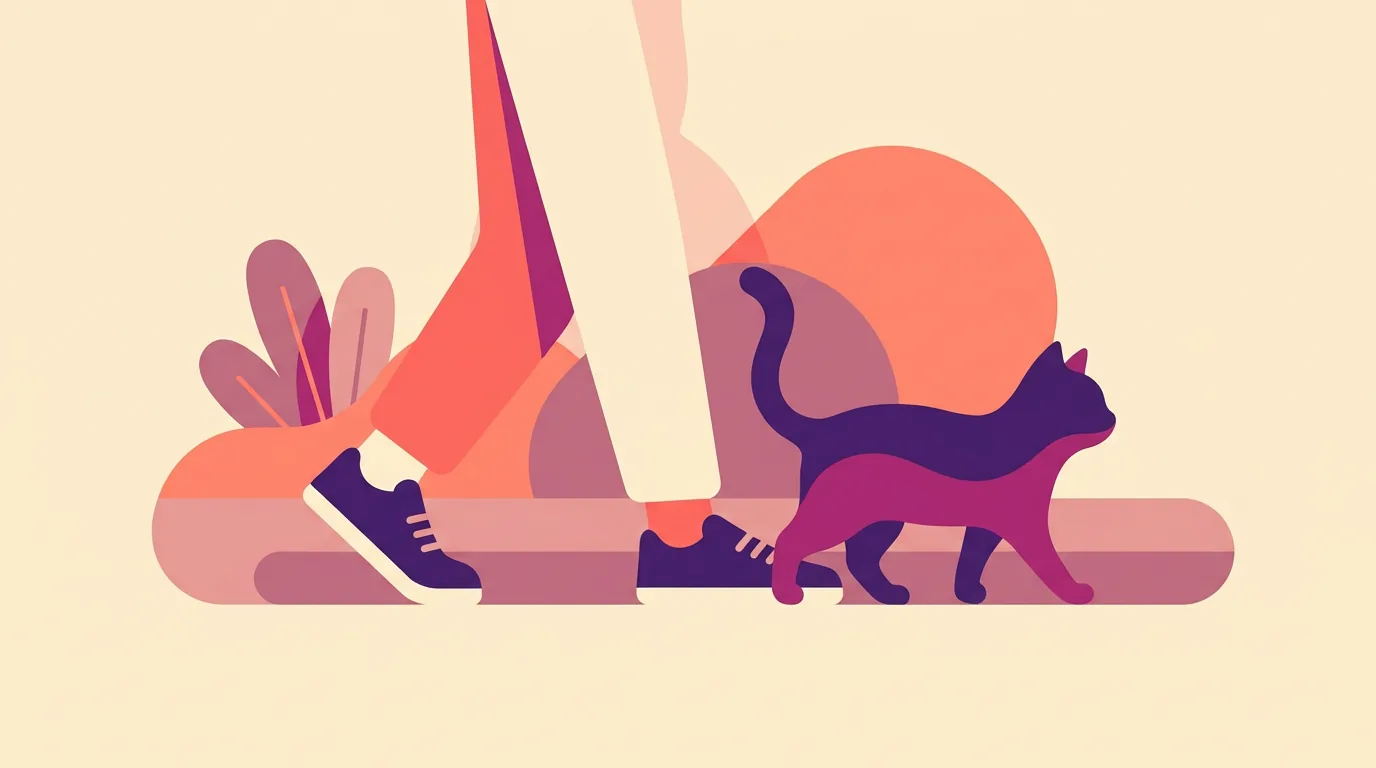
 🐱 Cat Mystery
The short answer
Your cat follows you because you’re their favorite — the source of food, safety, and affection. It’s bonding and curiosity, sometimes attention-seeking, and occasionally mild separation anxiety.
The idea that cats are aloof and self-sufficient is durable and largely wrong. Cats form genuine attachments to the people they live with, and a cat that follows you room to room is expressing one. What it means specifically depends on the cat, the timing and what else it is doing.
Cats are more social than their reputation suggests
Domestic cats are descended from a solitary ancestor, which is where the reputation comes from, but they are behaviourally flexible in a way that ancestor was not. Where resources allow, cats form social groups, and within those groups they maintain relationships through proximity, shared scent and mutual grooming.
Proximity is the key currency. Cats do not express attachment through the effusive greeting behaviour dogs use; they express it by choosing to be near you. A cat that relocates every time you change rooms is making a repeated, deliberate choice, and that is about as clear a statement as the species makes.
The usual reasons
- Attachment. You are the cat's primary social partner, and being in the same room is the behaviour that expresses it.
- Routine and resources. You operate the food, the door and the taps. Cats track the person who controls outcomes with considerable precision.
- Learned attention-seeking. Following has produced attention before — including negative attention. Cats repeat what works.
- Curiosity. Cats are strongly motivated to monitor changes in their environment, and you moving around the house is the most interesting thing happening.
- Warmth and comfort. You are a reliable heat source who periodically sits still. This is less romantic and frequently the real answer.
- Boredom. An indoor cat with insufficient stimulation follows for want of anything better. Common and fixable.
The bathroom question
Almost every owner asks this one. Several things converge: a closed door is an unacceptable barrier to a species that dislikes being excluded from part of its territory; running water is genuinely interesting to cats; you are stationary and predictable, which is the ideal condition for approaching; and the room usually smells intensely of you, which is reassuring.
There is also a simpler explanation. In many households the bathroom is the one place the person reliably stops moving and can be approached without competition from a laptop or a phone. From the cat's perspective that is a scheduling opportunity.
When following is worth a second look
Most following is unremarkable. A few patterns are not, and they share one feature: they are a change from your cat's own baseline.
- Sudden clinginess in a previously independent cat. Cats seek proximity when they feel unwell or insecure, and a marked change in social behaviour is one of the earliest signs owners notice of an underlying problem.
- Following combined with constant vocalising. Especially in cats over about seven, this combination raises hyperthyroidism, high blood pressure and cognitive dysfunction — all of which cause restlessness and increased vocalisation.
- Following with disorientation. An older cat that follows and then seems lost, stares, or becomes distressed in familiar rooms may be showing cognitive decline.
- Following with appetite or weight change, increased thirst, or litter box changes. Behaviour change plus any physical change deserves an appointment rather than observation.
- Anxious following. Pacing, inability to settle even when near you, over-grooming or hiding between bouts points to stress rather than affection.
Book a vet check if the change was sudden
New, marked clinginess in an adult cat — particularly alongside increased vocalisation, weight loss, increased thirst or urination, changes in appetite, or night-time restlessness — should be investigated. Hyperthyroidism is the most common endocrine disease of cats, it mostly affects middle-aged and older animals, it presents exactly this way, and it is diagnosed with a straightforward blood test and treatable.
If you would like a little more space
Punishing or shutting the cat out will not work and tends to increase the behaviour, because being excluded is precisely what the cat is objecting to. What works is giving the cat somewhere better to be.
Build a better option than your feet
Cats want height and a view. A cat tree, a cleared windowsill or a shelf near where you work usually beats following you, because it satisfies both proximity and the preference for elevated vantage points. Add two structured play sessions a day with a wand toy — ending with a meal, which mimics the natural hunt-eat-groom-sleep sequence — and much of the boredom-driven following disappears.
For attention-seeking specifically, the principle is the same as with any learned behaviour: stop rewarding the version you dislike, and reward the alternative generously. Give attention when your cat is settled nearby rather than when it is winding round your ankles, and be prepared for it to get slightly worse before it improves.
And it is worth keeping perspective. A species with a full repertoire of ways to avoid you, choosing instead to be in whatever room you are in, is paying you a compliment that is easy to take for granted.
Gear that actually helps
Hand-picked for this behavior. We may earn a small commission — at no cost to you.
Frequently asked
Why does my cat follow me everywhere?
Usually attachment. Cats express social bonds through proximity rather than effusive greeting, so choosing to be in your room is how the relationship is expressed. Routine, resources, learned attention-seeking, curiosity, warmth and boredom all add to it.
Why does my cat follow me into the bathroom?
A closed door excludes the cat from part of its territory, running water is interesting, the room smells strongly of you, and you are stationary and approachable. In many homes it is simply the one place you reliably stop moving.
Is my cat following me a sign of anxiety?
It can be, if it comes with pacing, inability to settle even beside you, over-grooming, or hiding between bouts. Relaxed following — the cat settles and sleeps once it arrives — is affection rather than anxiety.
My cat suddenly became clingy. Should I be worried?
A sudden, marked change from your cat's own baseline is worth a vet check, especially with increased vocalisation, weight loss, increased thirst or appetite change. Hyperthyroidism is common in middle-aged and older cats, presents this way, and is diagnosed with a simple blood test.
How do I get my cat to stop following me?
Do not shut the cat out — exclusion is what it is objecting to and it usually backfires. Provide a better option: a cat tree or cleared windowsill near where you sit, plus two structured wand-toy play sessions a day ending in a meal.
Do cats actually get attached to their owners?
Yes. The aloofness reputation comes from their solitary ancestor, but domestic cats are behaviourally flexible and form real social bonds, maintained through proximity, shared scent and mutual grooming rather than overt displays.
Sources
Every claim on this page is checked against published veterinary and animal-behaviour research. Here’s where it comes from.
- 1The Special Needs of the Senior Cat — Cornell Feline Health Center
- 2Cat Behavior Problems — Vocalization — VCA Animal Hospitals
Keep exploring
Why Does My Cat Follow Me to the Bathroom?
No privacy with a cat in the house. Here’s why the bathroom always comes with a feline chaperone.
 🐶 Dog Mystery
Why Does My Dog Follow Me Everywhere? The “Velcro Dog” Explained
Your dog is your shadow — even on bathroom trips. Mostly it’s love, with one thing worth watching for.
 🐱 Cat Mystery
Why Does My Cat Sleep So Much? Inside the 16-Hour Nap
Your cat is a professional napper, and there’s nothing lazy about it. Here’s the biology behind all that beauty sleep.
Why Does My Cat Lay on My Clothes?
Fresh laundry, worn hoodie, it doesn’t matter — your cat will claim it. Here’s the cozy reason why.
Why Does My Cat Sleep on My Pillow?
Your cat has claimed your pillow as their own. It’s a bigger compliment than it seems.
Why Does My Cat Lick the Wall?
Tongue to the wall? It’s odd but common — and here’s how to tell harmless curiosity from a red flag.